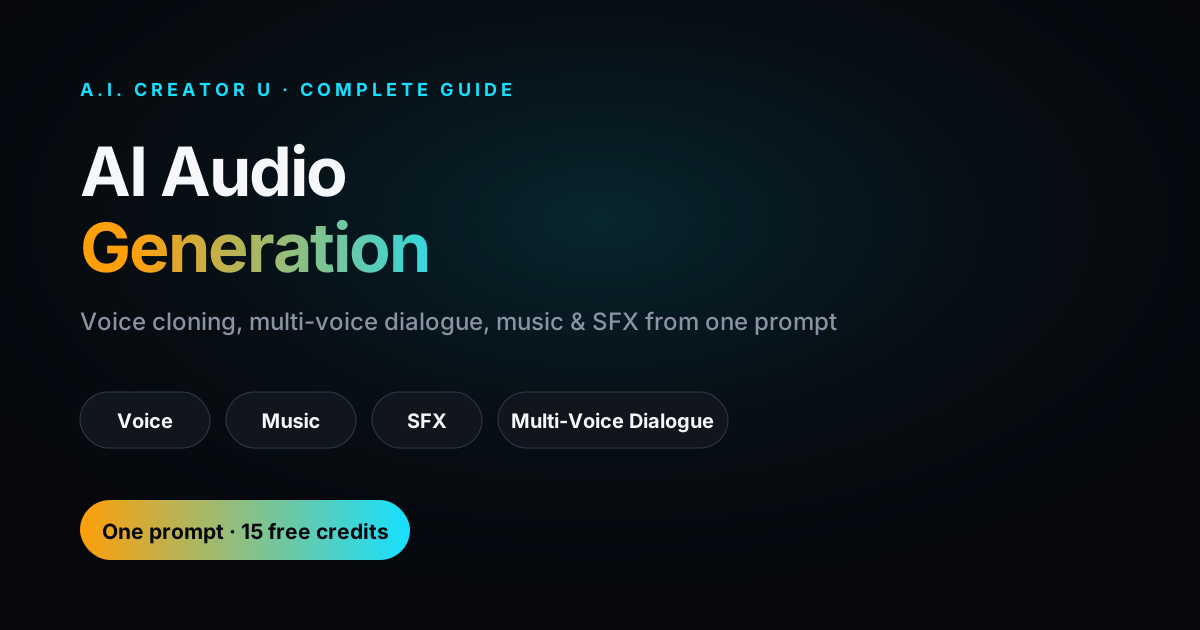
AI Audio Generation: The Complete Guide (2026)
Quick answer: AI audio generation is software that produces speech, music, or sound effects from a text prompt or a short reference clip instead of a microphone and a studio. In 2026 the category splits three ways: voice tools (ElevenLabs, Seed Audio) for narration and cloned voices, music tools (Suno, Udio) for full songs, and all-in-one models (ByteDance's Seed Audio, inside A.I. Creator U.'s Audio Studio) that do voice, music, and SFX from a single prompt. For creators making video content, the all-in-one route is faster because you're not exporting from three apps and syncing timestamps by hand.
A year ago, "AI audio" mostly meant a robotic text-to-speech voice reading your blog post out loud. That's not what it means anymore. You can now clone a voice from a 15-second clip, write a two-person conversation and get both voices back in one file, or type "tense orchestral swell, 8 seconds" and get a usable score cue. The tools got good enough that the bottleneck isn't quality anymore. It's knowing which tool does what, and how to direct it like you'd direct a voice actor or a composer.
This guide covers what AI audio generation actually is, the three categories of tools and where each one wins, a step-by-step framework for building a full audio track for a video, and the mistakes that make AI audio sound like AI audio.
What is AI audio generation, exactly?
It's any model that outputs sound (speech, music, or effects) from a prompt rather than a recording. Under the hood these are trained on huge libraries of audio paired with descriptions or transcripts, and at inference time they predict the audio waveform (or a compressed representation of it) that matches your input. Some models take only text. Others take a reference audio clip and clone its voice, tone, and cadence. The best ones can take both at once, in a single pass, so you get a specific voice saying specific words with the right emotion and pacing, no separate cloning step required.
The practical split that matters for creators is not "which model is technically best" but "what does it actually let you skip." A pure TTS tool skips the microphone. A voice-cloning tool skips hiring a voice actor. A multi-voice tool skips recording and editing two separate tracks and lining them up. An all-in-one tool skips switching apps entirely.
The three categories, honestly compared
| Category | What it's for | Strong picks | Where it wins | Where it doesn't |
|---|---|---|---|---|
| Voice / TTS + cloning | Narration, cloned voices, dubbing, voice agents | ElevenLabs | Widest language support (70+ with Eleven v3), real-time voice agents, dedicated dubbing tools | Music and SFX need a separate tool; voice cloning and generation aren't one prompt |
| Music generation | Full songs, background scores, jingles | Suno, Udio | Suno for fast, complete songs with vocals; Udio for instrumental control and stem separation | Neither does spoken narration or SFX; you're still stitching audio into your video separately |
| All-in-one (voice + music + SFX) | Video production where you need dialogue, a score, and effects in one file | Seed Audio (ByteDance), in A.I. Creator U.'s Audio Studio | One prompt produces speech, music, and sound effects together, already timed to each other; multi-voice dialogue in a single generation via reference clips | Not built for standalone music releases or enterprise voice agents; it's a video-production tool, not a DAW replacement |
ElevenLabs is still the benchmark if what you need is a voice agent, a dubbed audiobook, or the widest possible language coverage. It's a genuinely deep platform now, spanning TTS, speech-to-text, voice design, and conversational agents. If your job is narration at scale or real-time voice interaction, that's the tool.
Suno and Udio are the ones to reach for if the deliverable is a song. Suno optimizes for speed and complete tracks (vocals, instrumental, and production in one pass); Udio optimizes for control, with better stem separation and section-level editing. Neither one touches spoken dialogue or effects, because that's not the job.
The all-in-one lane is newer, and it's the one that matters most if your output is a video, not a standalone audio file. Seed Audio is the model we run in the Audio Studio here, and the pitch is specific: instead of generating a voiceover in one tool, a music bed in another, and a whoosh sound effect in a third, then dragging all three into a timeline and nudging them until they line up, you write one prompt that describes the whole scene and get one file back with dialogue, music, and effects already composed together.
How AI voice cloning actually works
Voice cloning takes a short reference clip (in Seed Audio's case, up to 30 seconds, and you can use up to three at once) and extracts the characteristics that make that voice sound like that voice: pitch range, timbre, pacing, accent. Then it applies those characteristics to new text you didn't record. The model isn't stitching together snippets of your original audio, it's generating new speech that matches the voice profile.
Quality depends heavily on your reference clip. A clean 20-second sample with no background noise, natural pacing, and some emotional range clones far better than a rushed 5-second clip recorded in a noisy room. If you've never cloned a voice before, our plain-English breakdown of how voice cloning works is worth reading before you touch a tool, and if you want to see the full workflow for cloning yourself specifically (voice and video together), we walked through that exact process step by step.
One thing worth being straight about: voice cloning is powerful enough to be misused, and every legitimate platform (ours included) requires that you have the right to use the voice you're cloning. Don't clone someone else's voice without their permission. That's not a legal disclaimer for show, it's the actual line between "creator tool" and "problem."
The multi-voice trick most people don't know about
This is the feature that changes how you'd actually use an all-in-one model versus a single-voice TTS tool. In the Audio Studio, you attach up to three reference clips, tag them @audio1, @audio2, and @audio3 in your prompt, assign a character to each one, and write the back-and-forth as a script. Seed Audio renders the entire conversation, with each voice kept distinct, in a single generation. No recording two takes, no lining up two audio tracks in an editor, no volume-matching between speakers.
That single feature is the difference between a UGC-style ad with two people talking and a single narrator reading both parts in a slightly different tone. It's a small thing that makes a huge difference in how "real" the final video feels. We go deep on the exact prompt structure for this in our full Seed Audio walkthrough, including a copy-paste template for a two-voice script.
A framework for building a full audio track
Here's the actual workflow, whether you're scoring a product ad, a faceless YouTube short, or a talking-head clip.
1. Write the scene, not just the line. Instead of "read this script," describe what's happening: who's talking, what mood, what's in the background. "Two friends in a car, one excited and one skeptical, light pop music underneath, city traffic ambience" gives the model far more to work with than a bare script.
2. Decide if you need cloned voices or generic ones. If brand consistency matters (the same narrator across every video), clone a voice once and reuse the reference clip. If you're testing an angle or don't have a locked brand voice yet, a strong generic voice is faster and there's nothing to manage.
3. Script the dialogue with speaker tags. For anything with more than one voice, structure it explicitly: @audio1: line, @audio2: line. Don't make the model guess who's talking.
4. Specify the music and SFX in the same prompt, not as an afterthought. "Tense low synth building through the pitch, then a bright chime on the reveal" gets you a score cue that's actually timed to your dialogue, because the model generates them together instead of you syncing two separate files after the fact.
5. Generate, listen critically, then adjust the prompt (not just regenerate blindly). If the pacing is off, say so directly: "slower on the second line" or "shorter pause before the reveal." Treat it like direction, not a slot machine.
6. Drop the finished audio straight into your video tool. Because this runs on the same credits as the rest of the platform, there's no separate API account to manage or file to re-upload from another service.
Where AI audio still falls short
It's worth being honest about the limits, because overselling this stuff is how creators end up disappointed. Emotional range on longer narration can still drift flat if you don't give the model direction ("more urgency here," not just a wall of text). Music generation, even from the best tools, isn't yet a reliable replacement for a composer who understands your brand's exact sonic identity across a whole campaign. And any voice clone is only as good as its reference clip, garbage in still means garbage out.
The honest read: AI audio generation has closed the gap on "does this sound like a real person/real instrument," and it's now mostly a direction problem, not a quality problem. The people getting the best results aren't the ones with the most expensive tool, they're the ones writing the most specific prompts.
FAQ
Is AI-generated audio royalty-free to use in my videos? It depends on the platform's terms, not on the fact that it's AI-generated. Read the specific tool's commercial-use terms before publishing. Audio generated in the Audio Studio is covered under your account's usage rights the same way generated video is.
Can I clone my own voice and use it across multiple videos? Yes. Upload a clean reference clip once, and you can reuse it in future prompts by tagging it the same way. That's the standard approach for creators who want a consistent narrator voice across a whole channel or brand.
Do I need separate tools for voice, music, and sound effects? Not necessarily. Dedicated tools like ElevenLabs (voice) or Suno (music) are still the strongest single-purpose options if that's your only deliverable. But if your output is a video that needs all three together, an all-in-one model like Seed Audio saves the step of generating each piece separately and syncing them by hand.
How long can a reference clip be for voice cloning? In the Audio Studio, reference clips can run up to 30 seconds, and you can use up to three different reference clips in a single generation to power multi-voice dialogue.
Does AI audio generation work for languages other than English? Yes, cross-lingual synthesis is one of the stronger features of current models, letting you generate speech in multiple languages without separately fine-tuning for each one. Quality varies by language, so it's worth testing your specific target language before committing to a full production run.
Try it yourself
If you're producing video content and tired of juggling a TTS tool, a music generator, and a sound effects library separately, the Audio Studio is built to collapse that into one prompt. Every new account starts with 15 free credits, enough to test a real multi-voice script and see whether the workflow actually fits how you make content.
Open the Audio Studio and try a two-voice dialogue prompt with a music bed underneath. It's the fastest way to feel the difference between generating three separate audio files and generating one scene.