How to Start a Faceless YouTube Channel with AI in 2026 (Without Getting Demonetized)
You don't need a camera, a face, or a studio to build a real YouTube channel anymore. You need a niche, a point of view, and a workflow that survives contact with YouTube's own rules. That last part is where most "faceless AI channel" advice from 2023 falls apart, because the platform has changed underneath it.
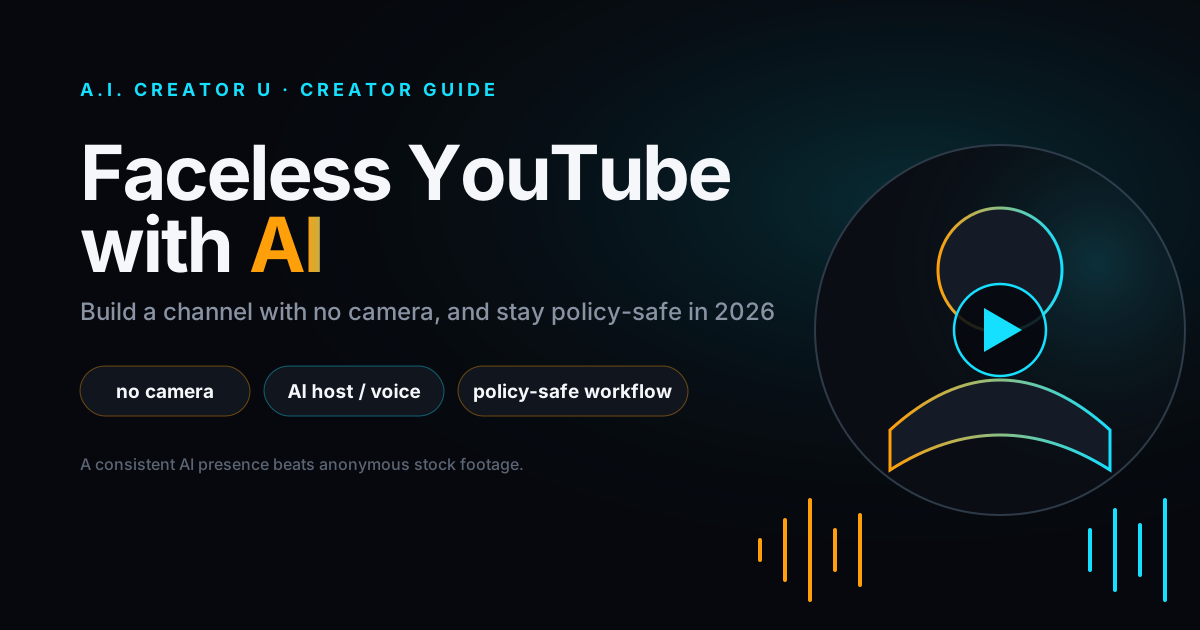
Quick answer: Yes, you can still build and monetize a faceless YouTube channel made with AI in 2026. YouTube renamed its old "repetitious content" policy to "inauthentic content" back in July 2025, and it now specifically targets mass-produced, template-driven videos with no original commentary, not AI tools themselves. The channels getting demonetized are the ones running the same script-to-voiceover-to-stock-footage template on autopilot. The ones that survive have a real angle, a consistent on-screen presence (even an AI one), and original editing choices. Build for that bar from day one and AI is a legitimate production method, not a liability.
What "Faceless" Actually Means Now
Faceless used to mean stock footage plus a text-to-speech voice reading a script scraped from Reddit. That format is exactly what YouTube is cracking down on. In 2026, "faceless" means something closer to "no camera pointed at my actual face," while everything else, voice, character, editing style, is deliberately consistent and recognizably yours.
That distinction matters because it changes what you're optimizing for. You're not hiding. You're choosing not to be on camera, and building a substitute presence, whether that's a narrator voice, an AI-generated host character, or a strong visual identity, that viewers come back for.
Does YouTube Still Allow AI-Made Faceless Channels?
Reportedly, yes, with conditions. Here's the shape of the policy as it's been described by outlets covering YouTube's Partner Program changes:
| What YouTube is checking for | Fails the bar | Passes the bar |
|---|---|---|
| Originality | Same script template reused across dozens of videos with only the topic swapped | A recognizable format, but each episode has new research, new angle, or new commentary |
| Disclosure | Realistic AI-generated or altered footage with the "altered or synthetic content" toggle left off | Toggling the disclosure setting in YouTube Studio when the content could pass as real |
| Value add | A blog post read aloud over stock clips, no new insight | Your own take, structure, or storytelling layered on top of the topic |
| Production pattern | Bulk-uploaded, interchangeable videos, clearly assembly-line | A channel with a voice (literal or figurative) viewers recognize |
The enforcement mechanism reported alongside this update is a graduated one: a warning, then a monetization suspension, then permanent removal from the Partner Program for channels that keep publishing template content after being flagged. None of that targets AI as a production tool. It targets low-effort duplication, which AI just made cheaper to produce at scale, so YouTube tightened the bar in response.
If you want the primary source, YouTube's own monetization policy page covers reused and repetitious content in detail, and it's worth reading once before you build anything at volume.
What You Actually Need to Start One
Strip away the tool marketing and a faceless channel needs five things:
- A niche you can sustain for 50+ videos. Not "AI" broadly, something narrow enough to own: overlooked physiology facts, ancient philosophy explained plainly, horror history, or "how to actually build with AI" as a beginner. Broad niches get buried; narrow ones get algorithmic trust faster.
- A script with a point of view. Facts alone are a commodity. Your framing, your ordering, your opinion on what matters is the part a template can't fake.
- A consistent presence. This is the piece most faceless creators skip, and it's the one YouTube is now checking for. It doesn't have to be your face. It has to be something recognizable: a voice, a character, a visual style.
- Visuals that match the pacing of the script. Stock footage looping under narration reads as filler. Purpose-built visuals, even simple ones, read as production.
- A publishing cadence you won't burn out on. Consistency compounds. A channel that posts twice a week for six months beats one that posts daily for three weeks and dies.
The Step-by-Step Framework
Here's the workflow that actually holds up against the 2026 rules, using tools built for exactly this.
1. Pick your niche and write to a real angle. Before touching any AI tool, write down your channel's one-sentence premise. Not "facts about space," but "space facts that make you rethink your day-to-day physics assumptions." That sentence is what keeps every script from reading like the last one.
2. Build a consistent on-screen presence with an AI character. This is the fix for the "inauthentic content" problem most faceless channels never solve. Instead of anonymous stock B-roll standing in for a host, Character Studio builds a persistent AI twin or original character, a face and voice viewers learn to recognize across every video, in a style that matches your brand. You never appear on camera, but your channel has a face. That's the difference between "generic AI slop" and "a show with a host."
3. Write and record narration with a real voice. Whether you're voicing the channel yourself and cloning it for consistency, or generating narration entirely, the Audio Studio's Seed Audio model handles both, including multilingual delivery if you want to repurpose the channel into other markets later. Consistent pacing and tone here does more for watch time than any visual trick.
4. Generate your visuals to match the script, not the other way around. This is where most faceless channels cut corners, and where the "same template every time" pattern gets flagged. Create Video runs on multiple current-generation models, Seedance 2.5, Kling 3.0, VEO 3.1, and others, so you're not locked into one look for 50 videos straight. Match the model to the shot: cinematic B-roll for a documentary-style channel, punchier motion for a listicle format, first-and-last-frame control when you need a scene to land on a specific beat.
5. Edit for pacing, not just presence. Cut on the sentence, not the clip length. A script-matched edit, where visuals change when the idea changes, is one of the clearest "a human made editorial choices here" signals, both to viewers and, per the policy language above, to YouTube's review process.
6. Toggle the disclosure setting and publish. If any shot could be mistaken for real footage, flip the "altered or synthetic content" toggle in YouTube Studio before you publish. It's a checkbox, not a monetization killer, skipping it because you're worried about the label is the actual risk.
Matching Tools to Each Step
| Step | What you need | Where to do it |
|---|---|---|
| Consistent host / character | A recognizable AI presence across every video | Character Studio |
| Narration / voiceover | A real or cloned voice, script-to-speech | Audio Studio (Seed Audio) |
| Scene generation | Video clips that match your script's pacing and tone | Create Video |
| Short-form spinoffs | Repurposing long-form beats into Shorts/Reels/TikTok | Brainrot / Short-form tools |
You don't need all four on day one. Most channels start with narration and scene generation, then add a consistent character once they know their format is working.
Two Mistakes That Get Faceless Channels Buried (Not Just Demonetized)
Mistake one: treating the script as disposable. If you're generating ten videos a week off the same three-sentence prompt template, you'll produce content that looks fine individually and reads as a pattern in aggregate, exactly what the inauthentic content policy is built to catch. Slow down on the script. It's the cheapest part of the pipeline and the highest leverage.
Mistake two: inconsistent presence. A different voice or visual style every video isn't variety, it's a channel viewers can't recognize. Algorithms and audiences both reward "I know what I'm getting when I click this." An AI character or a cloned, consistent voice solves this without ever putting your actual face on camera.
For the fuller playbook on building an audience without showing your face, including monetization paths beyond AdSense, our Faceless Content Playbook walks through the whole strategy layer. And if you're deciding between a literal AI twin and a fully original character for your channel's host, our guide to AI influencer generation covers the tradeoffs.
Ready to build your channel's host? Start with Character Studio, sign up and you'll have free credits to test the workflow before you commit to anything.
FAQ
Do I need to show my real face to run a successful faceless YouTube channel? No. The channels growing fastest in 2026 replace the face with something else recognizable: a consistent AI character, a distinct voice, or a strong visual format. What you can't skip is some consistent presence. Anonymous stock footage with no throughline is what gets flagged as low-effort.
Will using AI tools automatically get my channel demonetized? No. The policy targets mass-produced, template-driven, low-originality content, not AI production methods. A channel using AI for narration, characters, and visuals, but with real editorial choices behind each video, is treated the same as any other original channel.
What niches actually work for faceless AI channels right now? Narrow, sustainable niches beat broad ones: specific science curiosities, philosophy explained plainly, niche history, or practical AI tutorials. Avoid anything you can't credibly cover for 50+ videos without repeating yourself.
How long does it take to see traction? Realistically, three to six months of consistent posting before the algorithm has enough signal to push a channel meaningfully. Channels that quit at week three because early videos got sparse views are the majority failure mode, not a bad niche or bad tools.
Can I reuse the same AI character across multiple videos without it looking repetitive? Yes, and you should. A recognizable host is a feature, not a bug, as long as the scripts, framing, and visuals around that character keep changing. Consistency in presence plus variety in content is the combination that works.
Sources: YouTube channel monetization policies (YouTube Help), YouTube Clarifies Changes to Monetization Rules Around Inauthentic Content (Social Media Today)