AI Influencer Generator: How to Create One (2026 Guide)
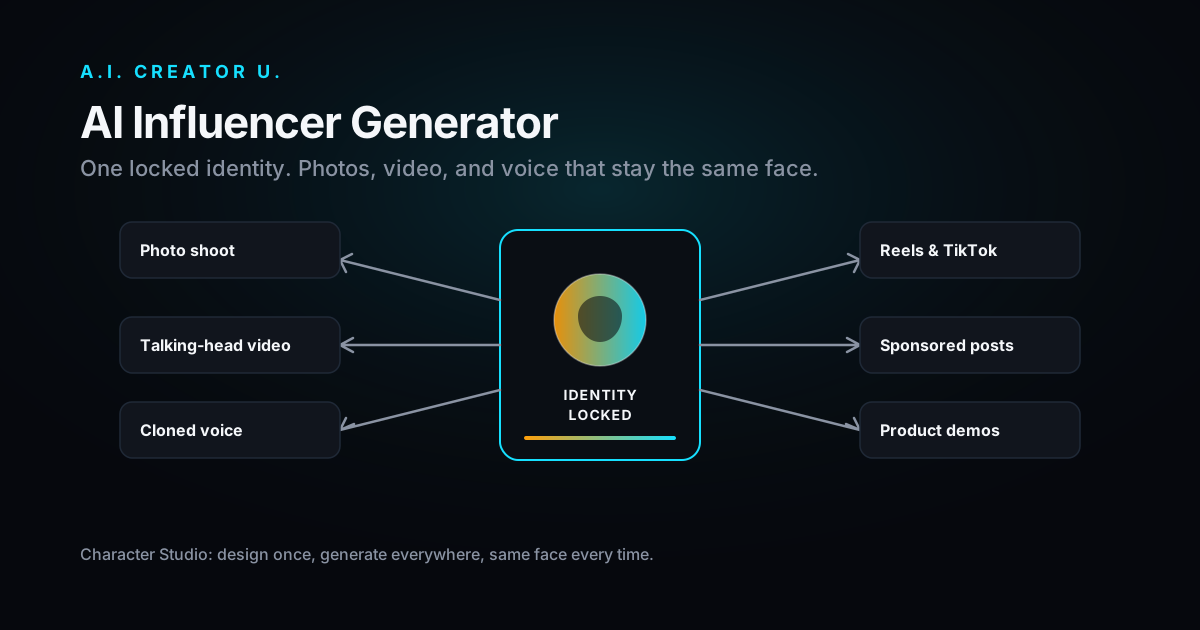
Quick answer: An AI influencer generator is a set of tools you chain together to design a consistent virtual face, generate photos and video of that face saying/doing things, give it a voice, and post on a schedule. There's no single "make my influencer" button anywhere yet, real or hyped. You need a character generator for the base identity, a video tool that can keep that identity consistent across shots, a voice, and a posting habit. This guide walks through the actual stack, using A.I. Creator U's Character Studio for the identity/video layer, plus what to expect once you go live.
If you've watched Lil Miquela or Aitana López rack up sponsorships and wondered whether a solo creator can do a version of that without a VFX studio, the honest answer is: yes, but the "generator" part is maybe 30% of the work. The other 70% is character design, consistency, and actually showing up every day. Let's get into it.
What is an AI influencer, really?
An AI influencer is a fictional persona, usually a face and a name, whose photos, videos, and captions are produced with generative AI instead of a camera and a human. Some are fully synthetic (no real person behind the face at all). Others are a real creator's likeness, cloned and automated, essentially an "AI twin" that posts more often than the human ever could.
The category has moved past novelty. The virtual influencer market was valued at roughly $6 billion in 2024 and is projected to reach $45.8 billion by 2030, and CMOs are reportedly shifting a real slice of influencer budgets, up to 30% at some brands, toward virtual talent instead of human creators (Metricool, Wayin.ai). Top AI influencers are reported to earn anywhere from $20,000 to $200,000 a month, with individual brand sponsorships from names like Prada, Calvin Klein, and Samsung reportedly running as high as $20,000 per post (SUCCESS). Those are the headline numbers you'll see everywhere; treat them as reported, not guaranteed, and know the vast majority of AI influencer accounts make nothing at all. Same as human influencers.
One stat worth taking seriously: virtual influencers reportedly average around 5.9% engagement compared to roughly 1.9% for human influencers, about three times higher (Wayin.ai). The theory is that people who follow an AI influencer chose to, deliberately, rather than getting served the account by an algorithm, so the audience that sticks around is more engaged from the start. It's a small, self-selected crowd, not a mass audience, at least early on.
The three things every AI influencer generator actually does
Strip away the marketing language and every tool in this space is solving the same three problems:
- Design the character. A face, a body type, a wardrobe, a name, a backstory. This is the one-time setup that everything else depends on.
- Keep that character consistent. The hard part. The same face has to show up correctly in a beach photo, a kitchen video, and a close-up talking-head clip, from every angle, in every lighting setup, without drifting into a slightly different person each time.
- Generate content on that character. Photos, video, voice, and eventually captions and replies, so the account has something to post daily or weekly.
Character consistency is the piece most tools quietly fail at. Generic image generators can produce a stunning face once and never reproduce it exactly again. That's the actual bottleneck in this whole category, and it's why "AI influencer generator" is really shorthand for "a character-locking pipeline," not a single magic prompt.
Step-by-step: building an AI influencer with Character Studio
Here's the workflow using A.I. Creator U's Character Studio, which handles identity locking and video generation in one place instead of forcing you to bounce between five disconnected apps.
1. Create the base identity
Upload reference photos (of yourself, if you're building an AI twin, or generated stills if you're building a fully synthetic persona) and Character Studio builds a locked identity profile from them. This is the reference the tool checks every future generation against, so the same face, same proportions, same distinguishing features show up whether you're generating a product review clip or a beach photo.
If you're starting from zero with no reference photos, generate a batch of face options first in a stills tool, pick the one you like, and feed that back in as your reference set. Don't skip straight to video generation before you've locked a face you're happy living with for the next year of content, because swapping identities later means rebuilding your whole audience's mental model of "who" the account is.
2. Generate stills across settings
Before touching video, build out a small photo library: different outfits, different locations, different expressions. This does two things. It stress-tests whether the identity actually holds up across varied prompts (if the face drifts in stills, it will drift worse in video), and it gives you a bank of static content for feed posts between video drops.
3. Generate video with the character locked in
Character Studio's video mode carries the same locked identity into motion, so your character can talk to camera, walk through a scene, or react to something, and it's recognizably the same person shot to shot. This is where most standalone image tools fall apart: they weren't built to hold a face steady across 100+ frames of video, only a single frame.
Keep clips short and purposeful early on. A 6 to 10 second talking-head clip with a clear hook in the first two seconds outperforms a meandering 20-second scene, and it's cheaper and faster to iterate on if the take isn't quite right.
4. Give it a voice
Text-to-video and text-to-image tools don't solve voice. For narration or lip-synced dialogue, you need a separate voice cloning or TTS pass. Seed Audio, A.I. Creator U's audio tool, handles multilingual voice cloning and can generate a consistent voice track you then sync to your video clips. What Is AI Voice Cloning? is a good primer if you're new to this part, and Best AI Voice Cloning Tools in 2026 breaks down the honest tradeoffs between options if you want to shop around before committing.
5. Write the caption and posting cadence, and stick to it
The generation stack gets all the attention, but the accounts that actually grow post on a real schedule, reply to comments in character, and have a consistent point of view, not just a consistent face. Treat the "character" like a character: give it opinions, a niche, and a voice in text as well as video. An AI influencer with no personality is just a stock photo that occasionally moves.
Fully synthetic vs. AI twin: which should you build?
| Fully synthetic persona | AI twin (your own likeness) | |
|---|---|---|
| Setup | Design a face from scratch, no real-world constraint | Upload your own reference photos, faster to a locked identity |
| Disclosure risk | Higher; audiences increasingly fatigued by obviously-AI faces, and the EU already requires disclosure | Lower; you can be upfront that it's an AI-assisted version of a real person |
| Growth ceiling | Can theoretically go bigger (Lil Miquela-scale), but takes longer to build trust | Grows faster if you already have any audience or niche credibility |
| Best fit | Brands, agencies, entertainment/fashion concepts | Solo creators who want to scale their own output without being on camera constantly |
If you already have a face people recognize, even a small one, the AI twin route gets you to "posting regularly" much faster because you skip the trust-building phase a synthetic persona needs. If you're an agency building a brand mascot from nothing, fully synthetic gives you more creative range, but budget for a longer runway before it earns anything.
Where AI influencers actually make money
Sponsorships get the headlines, but they're not the whole model, and they rarely come first. The realistic order for most creators:
- Affiliate and product links in captions and bio, the fastest thing to monetize because it doesn't require anyone to notice you first.
- UGC-style ad content for brands who want AI-generated demo or lifestyle footage without hiring a human creator or running a shoot. This overlaps heavily with the UGC creator space, just automated.
- Direct sponsorships, which come once the account has real, sustained engagement, not follower count alone. This is the slow one and the one most people quit before reaching.
- Selling your own product, digital or physical, where the AI influencer is the storefront's face rather than a middleman for someone else's brand.
Notice that three of the four don't require a single viral moment, they require consistency. That's the unglamorous truth behind those $20K sponsorship numbers: they're the ceiling, not the floor, and they show up after months of unremarkable, reliable posting.
The honest problems nobody puts in the pitch deck
Consistency drift. Even good tools slip. Faces get subtly younger, older, or "off" after enough generations, especially across different lighting and angles. Build in a review step before every post, not after you've already scheduled it.
Disclosure rules are tightening, not loosening. The EU already mandates disclosure for AI-generated influencer content, and platforms including Instagram are actively testing their own AI-content labeling. Don't build a strategy that assumes nobody will ever require you to say "this is AI." Say it upfront instead; audiences tend to punish the reveal much harder than the disclosure.
AI-face fatigue is real. The uncanny, overly-smooth "AI face" look is now recognizable to a lot of scrollers, and it triggers skepticism faster than it used to. A face with texture, asymmetry, and small imperfections reads as more trustworthy than a flawless one, whether it's real or generated.
The economics take longer than the case studies imply. Tool costs for a serious setup run somewhere in the $80 to $200 a month range once you're paying for character generation, video, and voice separately (starryAI), on top of your time. That's manageable, but it means you're investing months before the affiliate and sponsorship money catches up, if it ever does for your specific niche.
FAQ
Do I need to disclose that my influencer is AI-generated? In the EU, yes, disclosure is already a legal requirement for AI-generated influencer content, and other regions and platforms are moving the same direction. Even where it isn't mandated yet, disclosing upfront tends to build more trust than getting caught later.
Can I use my own face to build an AI influencer? Yes. That's the "AI twin" model. You upload reference photos of yourself, lock the identity in a tool like Character Studio, and generate content that's recognizably you, at a volume you couldn't hit filming everything yourself.
How much does it cost to run an AI influencer? Reported tool costs for a full stack (character, video, voice) run around $80 to $200 a month, plus whatever time you spend directing, reviewing, and posting. It's not free, but it's far cheaper than a studio, a camera crew, or a talent contract.
Why does my AI influencer's face keep changing between generations? Most generic image tools have no memory of "your" face between prompts, they just generate a new plausible face each time. You need a tool built specifically to lock and reuse an identity reference, which is the core problem Character Studio is built to solve.
Do AI influencers actually make money, or is that overstated? Some do, reportedly reaching six figures a month at the top end through sponsorships and product sales. Most don't, the same way most human influencer accounts don't. Affiliate links and UGC-style brand work tend to pay off before big sponsorship deals ever do, so build for that first.
Build the character, not just the content
An AI influencer generator isn't one tool, it's a pipeline: locked identity, consistent video, a real voice, and a posting habit that doesn't quit after week three. Character Studio handles the identity-locking and video half of that pipeline in one place, so you're not stitching together five separate apps and hoping the face matches across all of them.
If you want the voice side sorted next, Best AI Voice Cloning Tools in 2026 is the place to start, and if the monetization angle interests you more than the personal-brand angle, AI Spokesperson Video Generator: A Practical 2026 Guide covers the closely related brand-facing version of this same workflow.
Start with one locked face, ten stills, and three short clips. See if the identity holds up before you build a content calendar around it.