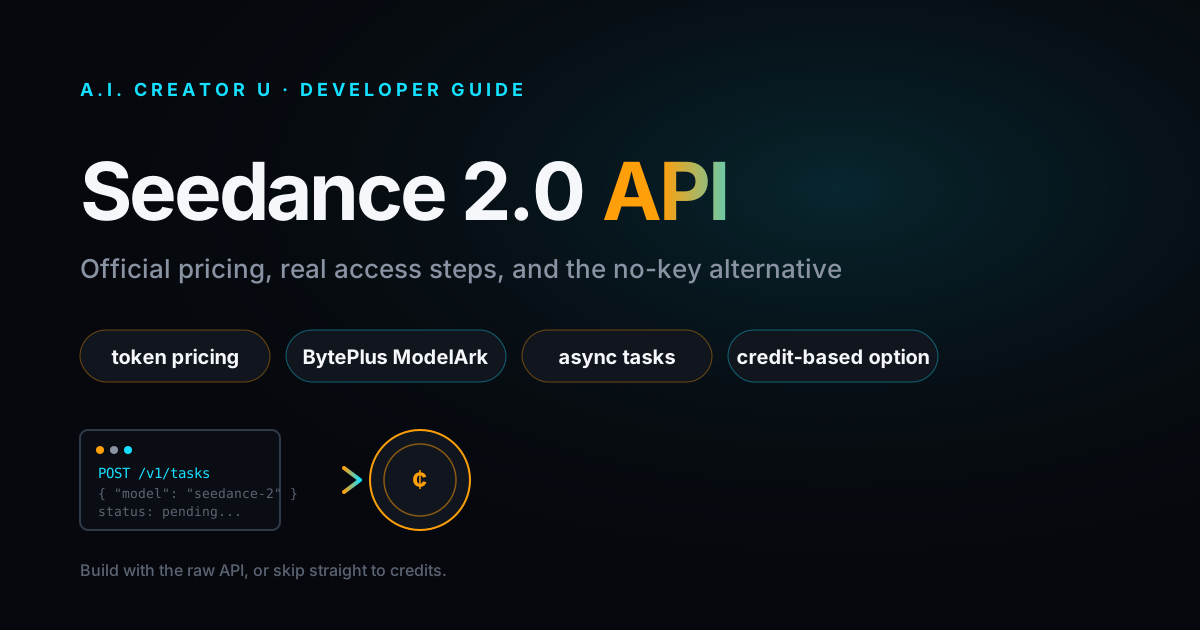
Quick answer: Yes, there's an official Seedance 2.0 API. ByteDance opened it to public beta on the BytePlus ModelArk platform in April 2026, and it runs on token-based pricing that works out to roughly $0.14 to $0.68 per second of video depending on tier and resolution. Third-party wrappers like fal.ai charge similar per-second rates without the real-name verification step. A.I. Creator U doesn't resell a raw API. We wrap Seedance 2.0 (and 2.5, Kling 3.0, VEO, Grok) inside a credit-based Create Video tool, so there's no key to manage, no token math, and no infrastructure to babysit. If you're a developer building a product on top of Seedance, the API is the right call. If you just want the videos, skip straight to the tool.
Most of what's written about the Seedance 2.0 API right now is either stale (from before it had an API at all) or wrong about who's actually selling access. Let's sort out what's real.
Is there an official Seedance 2.0 API?
Yes, as of April 2026. ByteDance runs Seedance through ModelArk, its model platform, split across two storefronts: Volcano Engine (Volcengine) for mainland China accounts with RMB billing, and BytePlus for international developers with USD billing and separate data-residency terms. Both expose the same underlying model, just with different account requirements and invoicing.
Getting in requires real-name verification in the console (a government ID or business registration, depending on region), but there's no waitlist or approval queue to sit in. Once you're verified, you can apply for access inside ModelArk and start hitting the API the same day.
The model ships in three tiers on the API side, mirroring what you'd see in a consumer tool: Fast (cheapest, lowest latency), Standard, and Pro (highest fidelity, slowest). All three support text-to-video, image-to-video, and reference-image-to-video through the same asynchronous workflow: you submit a generation task, poll for its status, then retrieve the result once it's done. There's no synchronous "wait and get your video back" call, which trips up developers coming from simpler image APIs.
During the public beta window, new accounts get a small monthly allotment of free Fast-tier calls, reported at around 20 a month. That's enough to test an integration. It is not enough to run a product on.
How much does the Seedance 2.0 API actually cost?
This is where it gets confusing, because ByteDance prices in tokens and everyone else prices in seconds. Here's the conversion, pulled from the official rate card and the major third-party resellers as of this writing.
| Provider | Tier | Reported rate | Notes |
|---|---|---|---|
| ByteDance (Volcano Engine, official) | Pure generation | ~46 CNY per million tokens (≈1 CNY/sec) | China billing, RMB invoicing |
| ByteDance (Volcano Engine, official) | Video-input / edit mode | ~28 CNY per million tokens | Cheaper than pure generation |
| fal.ai (third-party) | Standard, 720p | ~$0.30/sec | OpenAI-compatible endpoint |
| fal.ai (third-party) | Standard, 1080p | ~$0.68/sec | Roughly 2.2x the 720p rate |
| fal.ai (third-party) | Fast, image-to-video, 720p | ~$0.24/sec | Cheapest full-quality tier |
| fal.ai (third-party) | Mini, 480p / 720p | ~$0.04 to $0.09/sec | Budget tier, lower resolution |
A few things worth flagging. First, those Volcano Engine figures are China-market pricing reported by third-party trackers, not numbers we've verified against a live BytePlus invoice, so treat the CNY-to-USD math as a rough guide rather than gospel. Second, resolution changes the price more than duration does: jumping from 720p to 1080p on the Standard tier roughly doubles your per-second cost. Third, if you feed the model a reference video instead of just text or an image, some resellers apply a discount multiplier since the model has less to generate from scratch.
Run the math on a real clip and it adds up fast. A 15-second 1080p video on fal.ai's Standard tier lands north of $10 for a single generation, before you've hit retry once. That's the number that sends most people looking for an alternative.
Do you need a Chinese account to use the Seedance 2.0 API?
No, not anymore, and this is the most outdated piece of advice still floating around. Seedance 2.0 launched in China first, and for a while the only path in really did run through a mainland account and a China-based payment method. BytePlus closed that gap when it opened international access with USD billing. If you're outside China, use BytePlus, not Volcengine, and you won't need a VPN, a local phone number, or a workaround account.
That's the same access gap we cover for the consumer-facing tool in how to use Seedance 2.0 in the US without a Chinese account, and the short version applies here too: the "you need a China-only account" narrative is stale by several months.
Does A.I. Creator U offer a Seedance 2.0 API?
Honestly, no, and we're not going to pretend otherwise. A.I. Creator U doesn't expose a public developer API today. What we offer instead is the Create Video tool: a credit-based interface where you pick Seedance 2 (or 2.5, Kling 3.0, VEO, Grok), set your duration and resolution, drop in your references, and generate. No key, no async polling loop, no token accounting.
Here's what that actually costs, pulled straight from our live pricing logic rather than estimated: a 5-second Seedance 2 (Fast) clip runs about 7 credits, 10 seconds runs about 14, and 15 seconds runs about 20, at $0.08 per credit. That puts you in the same rough ballpark as the raw Fast-tier API rate, minus the account setup, the polling code, and the token math. New accounts start with up to 16 free credits split across two welcome bonuses (both expire after 14 days), which is enough to test the model before you commit to anything.
We're not the right answer if you're building a product that needs to call Seedance programmatically at scale, queue thousands of generations a day, or integrate video generation into your own SaaS. That's a real use case, and the official API (or a wrapper like fal.ai) is genuinely the better tool for it. We're the right answer if you're a creator, marketer, or seller who wants the video and doesn't want to become a part-time backend developer to get it. Most people asking "how do I get the Seedance 2.0 API" actually just want the second thing and haven't realized it yet.
Getting official API access, step by step
If you've read the above and you still need the raw API (building a product, automating a pipeline, whatever the reason), here's the actual path:
- Pick your storefront. BytePlus if you're outside mainland China and want USD billing. Volcengine if you're in China and want RMB invoicing.
- Complete real-name verification. A government ID for individuals, or business registration documents for companies. This gates account creation, not each API call.
- Apply for ModelArk access inside the console. No whitelist required as of the April 2026 public beta, so approval is fast.
- Generate an API key and read the signature-authentication docs before your first call. ModelArk uses signed requests, not a simple bearer token, which catches people off guard coming from OpenAI-style APIs.
- Submit a generation task specifying tier (Fast, Standard, or Pro), input mode (text, image, or reference video), duration, and resolution.
- Poll the task status endpoint until the job completes, then retrieve the result URL. Build retry and timeout handling into this loop from day one. Async video generation fails and stalls more often than a typical text API call.
- Track your token spend against the rate card as you scale. Tokens accumulate fast on longer, higher-resolution clips, and there's no built-in spending cap by default, so set one yourself.
If step 4 already sounds like a headache, that's a signal, not a complaint. It means you're the audience for a credit-based tool, not the raw API.
API vs. no-code tool: which one should you actually use?
Ask yourself one question: are you building software that other people will use, or are you making videos?
If you're building software, meaning you need Seedance calls embedded inside your own app, triggered by your own users, at a volume you control, the API is the correct layer. You'll eat the integration cost once and amortize it across every generation after that.
If you're making videos, meaning you personally (or your team) need finished clips for ads, social content, or client work, the API is overhead you don't need. You're paying developer time to rebuild a queueing system, a retry loop, and a billing dashboard that already exists in a $0.08-a-credit tool. That's not a knock on the API. It's just the wrong tool for that job, the same way you wouldn't spin up AWS Lambda to resize one photo.
Common mistakes people make with the Seedance 2.0 API
A few patterns show up constantly in developer forums and support threads:
- Assuming synchronous responses. The API is async. If your code expects a video URL back in the same request that started the job, it will break the first time a generation takes more than a few seconds, which is most of the time.
- Underestimating token cost at 1080p. Teams budget for 720p pricing during testing, then get surprised when production traffic runs at 1080p and the bill roughly doubles.
- Skipping the real-name verification step until launch week. It's not instant for every account type, especially business accounts. Do it early.
- Not setting a spend ceiling. Token-based billing with no default cap is exactly how a bad prompt loop or a retry bug turns into an unexpectedly large invoice.
- Confusing Seedance 2.0 with Seedance 2 Mini. They're priced and specced differently. If you're comparing rates, make sure you're reading the right row on the card.
Try it without the setup
If everything above sounds like more infrastructure than your project needs, that's the whole point of the credit-based route. Open Create Video on A.I. Creator U, pick Seedance 2 from the model list, and generate your first clip in the time it would've taken to read the ModelArk signature-authentication docs. No account verification beyond a normal signup, no token math, no polling loop to write.
For the fuller picture on what the model can actually do once you're in, see what Seedance 2.0 is and how it works, and for a hands-on walkthrough of building your first clip, how to make videos with Seedance 2.0 covers prompt structure and reference inputs step by step. Both link back to the full AI video generation guide if you want the wider landscape of models beyond just Seedance.
FAQ
Is the Seedance 2.0 API free? No. There's a small free monthly allotment of Fast-tier calls during the public beta (reported around 20 a month), enough to test, not enough to run anything real. Everything past that is metered by token.
Can I use the Seedance 2.0 API without a Chinese account? Yes. BytePlus offers international access with USD billing and doesn't require a mainland China account, a local phone number, or a VPN.
Is Seedance 2.0's API pricing the same everywhere? No. Official ByteDance pricing through Volcano Engine and BytePlus differs from third-party resellers like fal.ai, and rates shift by tier (Fast, Standard, Pro) and resolution (480p through 1080p). Always check the current rate card before estimating a project's cost.
Does A.I. Creator U have a Seedance 2.0 API? Not a public one. We run Seedance 2, Seedance 2.5, Kling 3.0, VEO, and Grok through a credit-based Create Video tool instead, which covers the "I just want the video" use case without any API integration work.
Who actually needs the raw Seedance 2.0 API instead of a tool like this? Developers building their own product on top of Seedance: a SaaS feature, an automated content pipeline, or anything that needs to trigger generations programmatically at volume outside a human clicking a button. Everyone else is better served by a credit-based interface.