Quick answer: MAGI-2 is Sand AI's AI video model. It makes up to 30 seconds of 1080p video with synchronized sound in one pass, from a text prompt, a start and end frame, or a stack of image, video and audio references. You can run the hosted MAGI-2 on A.I. Creator U. from 8 credits for a 5 second clip.
Three facts before you spend a credit:
- Two versions exist. The open MAGI-2 Preview (114B parameters, 10 second clips, needs 8 data-center GPUs) and the hosted MAGI-2 that runs up to 30 seconds.
- It edits like a film. Ask for a sequence and it gives you cuts, angles and sound from one prompt.
- It is cheap for 1080p. In our five-model test it cost 8 credits for 5 seconds at 1080p. Three of the other four cost more at 720p.
We ran it on real prompts, one take each. Here is what it does well, where it slips, and exactly how to use it.
MAGI-2 in action: one prompt, one 30 second film
Most pages ranking for MAGI-2 right now are model cards and launch news. None of them show you what the hosted 30 second version actually returns. So here is ours.
The prompt described a golden-hour desert highway chase as a sequence of shots, with sound design: a black muscle car closes on a semi, slides under the trailer throwing sparks, then transforms mid-road into a towering robot.
Figure 1: "Iron Highway", made with MAGI-2 from one prompt, 30 s at 1080p, 48 credits, one take. Source: A.I. Creator U. studio test, November 2026.
Watch the full video (MP4, 0:30)
What this clip shows: real daylight, several cuts the model chose on its own, and the full slide-and-transform beat in a single generation. Sand AI's own site calls this "autonomous camera planning". We call it a model with opinions about editing.
MAGI-2 specs: the open preview vs the hosted model
This is where most write-ups get confused, so here it is plainly.
On August 5, 2026, Sand AI published MAGI-2 Preview, which it calls "an intermediate research release". Its model card on Hugging Face lists 114B total parameters with about 6B active per token, text-to-video and image-to-video, and 10 seconds as "the only duration the model currently supports".
Separately, Sand AI's homepage introduces MAGI-2 as supporting "up to 30 seconds of native 1080P audio-video content in a single pass", with multimodal referencing and precise editing. That is the model you can run on A.I. Creator U. Sand AI has not published a parameter count for it, so we won't guess one.
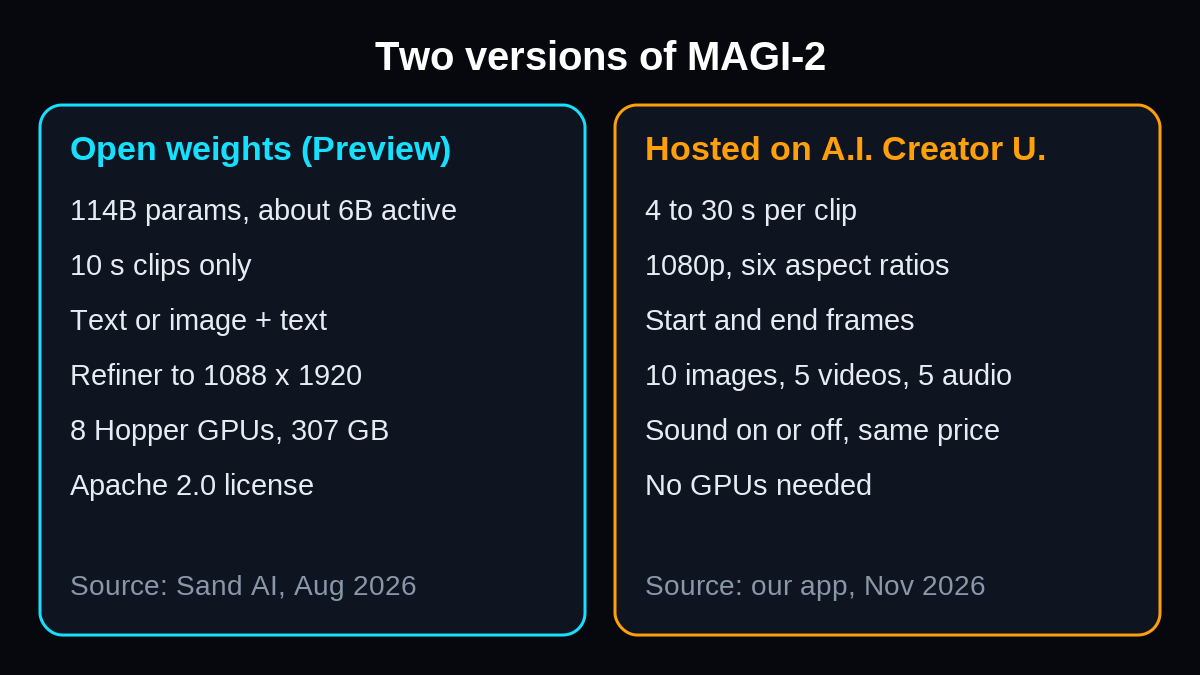
Figure 2: Open MAGI-2 Preview vs hosted MAGI-2. Source: Sand AI model card and blog (August 2026), A.I. Creator U. app (November 2026).
| MAGI-2 Preview (open weights) | MAGI-2 on A.I. Creator U. | |
|---|---|---|
| Clip length | 10 s only | 4 to 30 s |
| Resolution | 512x896 preview, refiner to 1088x1920 | 1080p |
| Aspect ratios | set by output size | 21:9, 16:9, 4:3, 1:1, 3:4, 9:16 |
| Inputs | text, or image plus text | text, start and end frames, up to 10 images, 5 videos, 5 audio clips |
| Sound | generated with the video | on or off, same price |
| Hardware | 8 NVIDIA Hopper GPUs, about 307 GB of weights | none, runs in the browser |
| License | Apache 2.0 | hosted, per A.I. Creator U. terms |
| Typical render | not stated | 3 to 10 minutes |
Sources: MAGI-2 Preview on GitHub and Hugging Face, checked November 2026; hosted specs from the A.I. Creator U. app the same day.
Is MAGI-2 open source?
The Preview is. Code and weights are on GitHub and Hugging Face under Apache 2.0, so you can study it, fine-tune it and use it commercially within that license.
Can you run it at home? Realistically, no. The model card asks for 8 Hopper-class GPUs and about 307 GB of checkpoints, and notes that the preview and refiner stages don't fit on one 80 GB card together at 1080p. Sand AI lists a distilled, faster version as "coming soon". If you own a gaming PC, the hosted route is the one that ends with a video.
How to use MAGI-2 on A.I. Creator U., step by step
MAGI-2 sits in the same Create Video picker as Seedance 2.5, Kling 4.0, Wan 3.0 and Velocity Surge, so one login covers all of them.
- Open Create Video and pick MAGI-2 from the model list.
- Choose your input. Text only, Start and End Frames (a first frame and an optional last frame), or Multi Reference (up to 10 images, 5 video clips and 5 audio clips, each clip 2 to 30 seconds, 30 seconds combined per kind).
- Name your references as @image1, @video1, @audio1. MAGI-2 reads plain language, so the app quietly rewrites those into "the first reference image" for you.
- Set length and shape. Anywhere from 4 to 30 seconds, six aspect ratios. Resolution is always 1080p.
- Leave sound on unless you'll score it yourself. Off costs the same.
- Check the quote and generate. The composer shows the exact credit price first. Expect 3 to 10 minutes.
Our rule from shipping real work: test short before you spend. Run 5 seconds (8 credits) of your hardest shot before you commit 48 credits to a 30 second take. Most bad takes show it in the first second.
Run your first MAGI-2 clip free: free credits when you sign up, and the MAGI-2 model page shows the live price table.
MAGI-2 vs Seedance 2.5, Kling 4.0, Wan 3.0 and Velocity Surge
We gave five models the same three prompts: 5 seconds, 16:9, text only, no references, one take each, no cherry-picking. One difference to keep in mind: MAGI-2 ran at 1080p (its only option) and the other four at 720p.
Product shot with on-screen text: MAGI-2's best result
The prompt asked for a matte black earbud case on wet black stone, "NOCTURNE AUDIO" engraved on the lid, a slow orbit, and the lid opening on a crisp click.
Figure 3: MAGI-2 product shot, 5 s at 1080p, 8 credits, one take. Source: A.I. Creator U. studio test, November 2026.
The lettering is crisp, the case stays matte black, and the lid opens on cue to glowing amber-ringed earbuds. It was one of the cleanest product shots of the five. Here are the other four models on the identical prompt:
Figure 4: The same product prompt on Seedance 2.5, Kling 4.0, Wan 3.0 and Velocity Surge, 720p, one take each. Source: A.I. Creator U. studio test, November 2026.
All four rendered the text legibly too. Seedance 2.5 drifted to a warm bronze case, Kling 4.0 and Velocity Surge kept the matte black closest, and Wan 3.0 had the strongest glow. Winner for product shots: MAGI-2, by a nose, and at 1080p.
Action and camera move: where it takes liberties
A skateboarder in a red hoodie bombs down a steep San Francisco hill past two cable cars, camera low at wheel height. MAGI-2 gave a clean ride, but it flattened the steep hill into a level street and cut to a front angle halfway through. In a 5 second clip, that is a choice you didn't ask for.
Watch MAGI-2's skateboard take (MP4, 0:05)
Kling 4.0 had the cleanest camera move, and Wan 3.0 and Velocity Surge nailed the cable cars and red hoodie. Winner for one continuous action shot: Kling 4.0. Our full breakdown is in the Kling 4.0 guide.
Talking character: expressive, not yet verified
A fisherwoman on a rainy dock says one line to camera. MAGI-2 went tight with gulls, a lantern and crashing waves all in frame, and gave a very expressive delivery. We haven't transcribed its line yet, so we won't claim it said it word for word. The other four did, by transcription.
What it cost
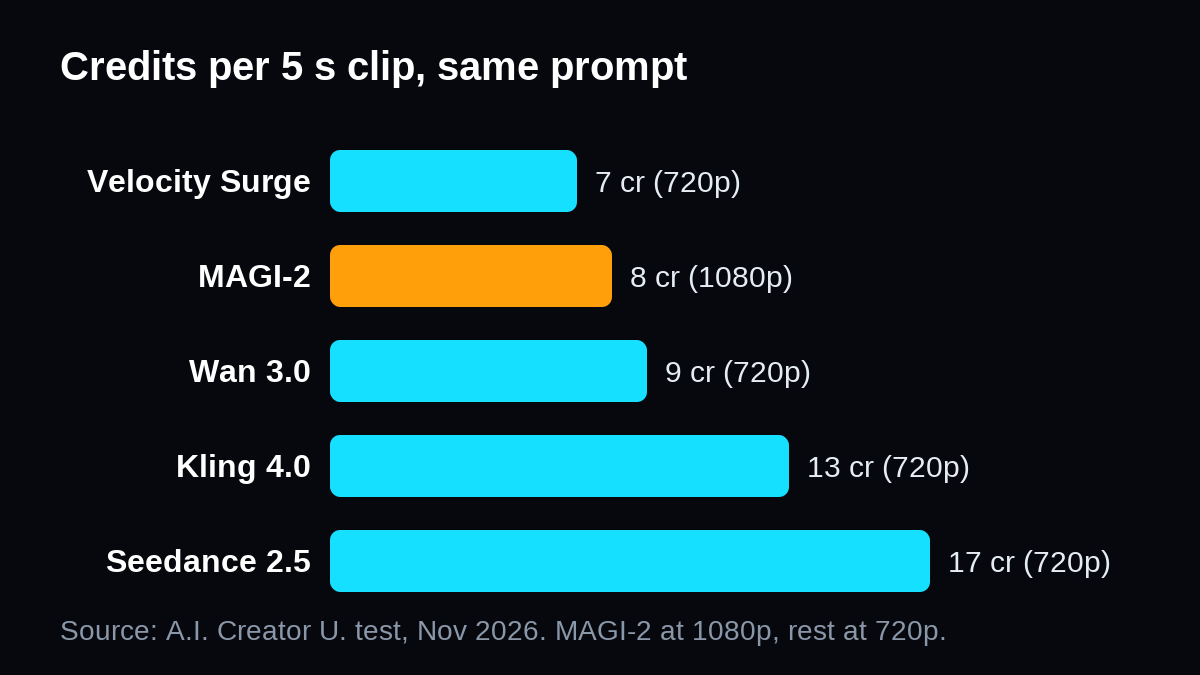
Figure 5: Credits per 5 second clip in our same-prompt test. MAGI-2 at 1080p, the rest at 720p. Source: A.I. Creator U., November 2026.
Per second, MAGI-2 was the cheapest model in our lineup at its resolution. Only Velocity Surge came in lower, at 720p.
MAGI-2 pricing in credits
MAGI-2 is priced per second of 1080p, and sound or references don't change the rate. As of November 2026, the live price table on A.I. Creator U. reads:
| Clip length | Credits (1080p) |
|---|---|
| 5 s | 8 |
| 10 s | 16 |
| 15 s | 24 |
| 30 s | 48 |
The composer always shows the exact quote before you generate. To see how that stacks up against the budget models, here's the cheapest AI video model at every resolution.
MAGI-2 prompts you can copy
MAGI-2 is strongest when one prompt asks for a short film. Write shots, not a paragraph.
Multi-shot sequence (template):
Shot 1: wide establishing shot of [place] at [time of day], [weather]. Shot 2: medium shot, [subject] [action]. Shot 3: close-up on [detail] as [moment]. Sound: [ambient], [key effect] on the cut, [music style] building to the end. Natural light, no neon.
Product shot (our exact test prompt):
Macro product shot of a matte black wireless earbud case resting on wet black stone. The lid slowly opens to reveal two softly glowing earbuds while water droplets bead on the surface. The words "NOCTURNE AUDIO" are cleanly engraved in white sans-serif letters on the lid. Slow orbiting dolly, soft rim light, a low bass hum and a crisp click as the lid opens.
Reference-driven shot:
The person in @image1 walks through the street from @video1, matching its camera move. Background sound from @audio1. Keep their face and jacket identical in every shot.
More structure ideas live in our guide to AI video prompts that actually work.
Where MAGI-2 slips
Concede the misses, or nobody should trust the wins.
- One continuous take gets simplified. Ask for a single unbroken move and it may cut anyway, as the skateboard clip did.
- Fast choreography loses detail. In a 10 second rooftop fight test (16 credits), both fighters stayed the same person throughout and the crate smash burst into splinters, but the spinning kick and elbow we asked for were simplified, and background signs came out as garbled text.
Figure 6: MAGI-2 rooftop fight test, 10 s at 1080p, 16 credits, one take. Source: A.I. Creator U. studio test, November 2026.
- 1080p only. No cheap 480p drafts for checking motion. Your test clip is a 5 second 1080p clip.
- No voice cloning, extend or video edit on A.I. Creator U. today. For edits, Seedance 2.5 handles prompt-driven video editing.
- The Preview is a research release. Sand AI's own blog calls its observed strengths "qualitative observations" and says more parameters don't automatically produce a better model.
Our take: pick the model for the shot, not the brand. MAGI-2 for multi-shot sequences and product beauty shots. Kling 4.0 when the camera move must be exact. Velocity Surge when budget wins. The complete guide to AI video generation maps the rest.
Bottom line: is MAGI-2 worth it?
Yes, for the right shot. MAGI-2 turns one well-written prompt into a 30 second, 1080p, cut-together film with sound, for 48 credits, and it was one of the cheapest models in our test per second. It's less obedient when you want one continuous move.
The fastest way to know if it fits your project: paste the same prompt into MAGI-2 and one rival, then keep the better take.
Turn your prompt into a 1080p MAGI-2 film: free credits when you sign up, one login for every model in the picker.