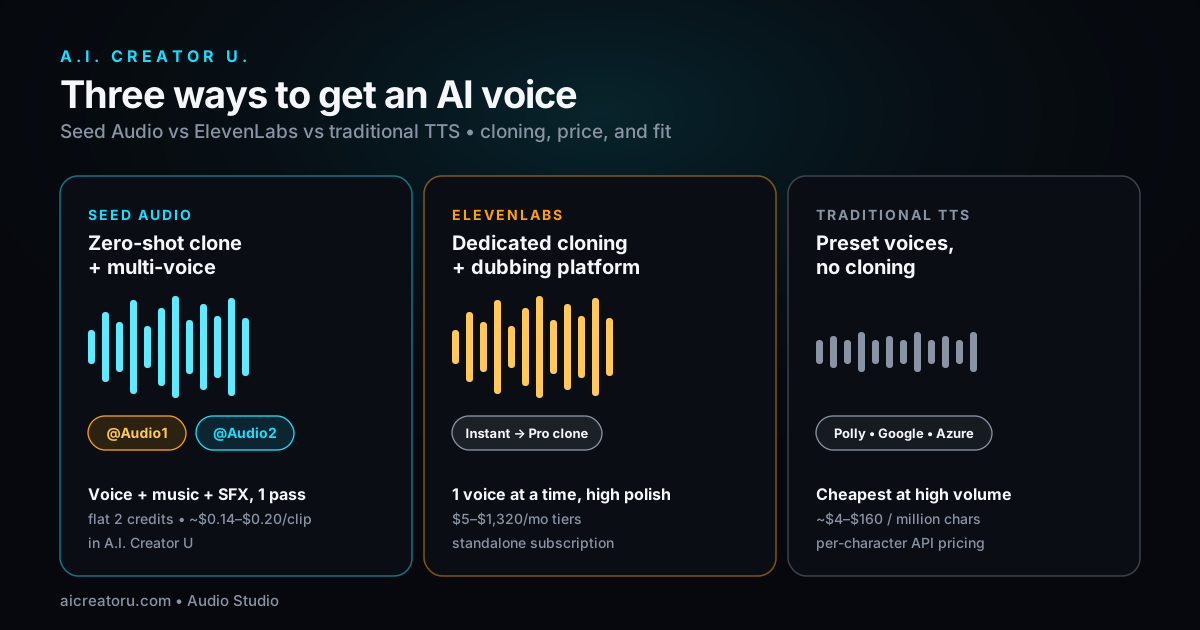
Quick answer: Traditional TTS engines (Amazon Polly, Google Cloud, Azure) are the cheapest way to get a clean, robotic-to-decent voice reading text, and they're priced per character with no cloning option at all. ElevenLabs is the standalone specialist for voice cloning, with tiered plans from $5 to $1,320 a month depending on how much Instant or Professional cloning you need. Seed Audio is ByteDance's zero-shot cloning model built into A.I. Creator U, and it's the only one of the three that also handles multi-speaker dialogue, cinematic sound effects, and background music in the same generation, at a flat 2 credits (about $0.14-$0.20) per clip. If you just need narration, use traditional TTS. If you need to sound like a specific person, or you're already making AI video and want the audio to live in the same workflow, that's where Seed Audio and ElevenLabs actually compete.
What's the Real Difference Between Voice Cloning and Traditional TTS?
People use "AI voice" to mean two very different things, and mixing them up is how you end up paying for the wrong tool.
Traditional TTS takes text and reads it in a voice someone else recorded and trained a model on. You pick from a library. Amazon Polly, Google Cloud Text-to-Speech, and Azure AI Speech all work this way. You're not cloning anyone. You're renting a voice actor who happens to be a neural network.
Voice cloning takes a sample of a real voice (a person, a character, a brand) and generates new speech in that voice. ElevenLabs and Seed Audio both do this, but they get there differently. ElevenLabs is built as a dedicated voice platform: record or upload a sample, choose Instant or Professional cloning, then generate speech or dub existing audio. Seed Audio is a generation model wired into a full AI content studio, so cloning is one mode among several: reference-based cloning, image-to-voice, multi-speaker dialogue, and ambient sound, all from one prompt box.
Neither approach is "better" in the abstract. The right one depends on whether you need a voice that sounds like your content, or a voice that just sounds acceptable reading a script.
What Is Seed Audio and What Can It Actually Do?
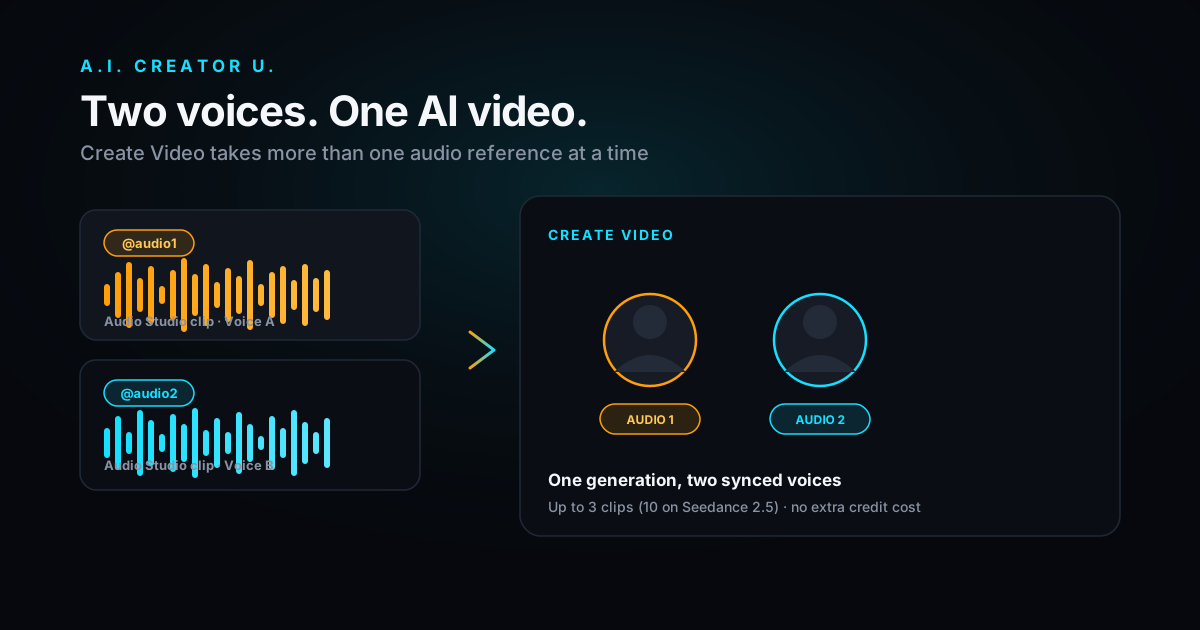
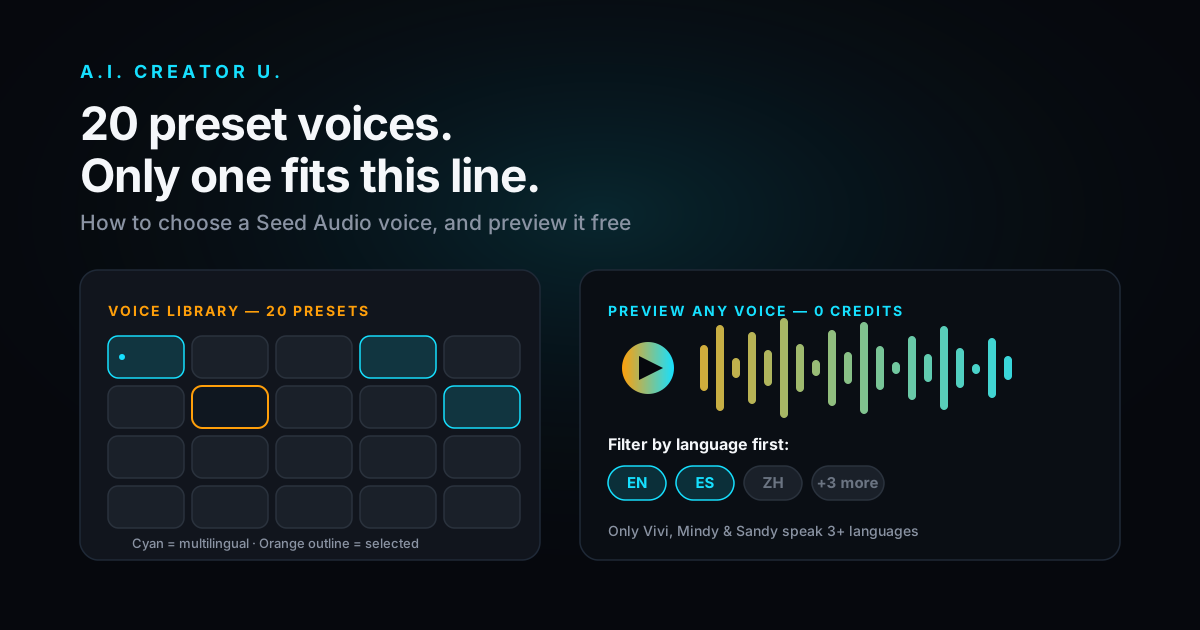
Seed Audio is ByteDance's audio model, available inside A.I. Creator U's Audio Studio. The core trick is zero-shot cloning: you drop in up to three reference clips (30 seconds or less, under 10MB each), tag them @Audio1, @Audio2, @Audio3 inline in your prompt, and it generates new speech in those voices without any training step or waiting period. You can also clone a voice from a single reference image instead of audio (the model infers a plausible voice from a face), or skip cloning entirely and pick from 19 built-in preset voices, several of which are explicitly multilingual (mixed English/Chinese/Japanese/Spanish/Indonesian pairings, for example).
The multi-speaker tagging is the feature that makes Seed Audio genuinely different from a plain TTS tool: because you can reference up to three distinct voices in one prompt, you can write an actual back-and-forth dialogue and get it generated in a single pass, with each speaker staying consistent. We've written a full breakdown of that workflow if you want the exact syntax: How to Make Multi-Voice AI Dialogue (the @Audio Trick).
Output comes back as mp3, wav, pcm, or ogg_opus, with sample rates from 8k up to 48k. Prompts can run up to 2,048 characters, and because the model isn't purely doing TTS, that prompt space can include direction for music, sound effects, or emotional delivery, not just the words to say.
One honest limitation: Seed Audio doesn't currently do voice-swap-on-existing-video or automatic dubbing/translation of existing footage. Those are marked as coming soon in the Audio Studio interface, not live yet. If you need to change the voice track on an already-recorded video today, that's not what this tool does.
Pricing is flat: 2 credits per generation, regardless of clip length. At the platform's cheapest tiers that works out to roughly $0.14 to $0.20 a clip, depending on whether you're on a subscription or buying a one-time credit pack. There's a wrinkle worth stating plainly: Audio Studio is gated behind hasEverPaid, meaning any credit purchase (even the smallest starter pack) unlocks it permanently, but the platform's signup credits alone won't get you in. If you're brand new and haven't bought credits yet, you'll need to make one purchase before Seed Audio is available to you.
What Is ElevenLabs and What Do You Get at Each Tier?
ElevenLabs is a standalone voice AI company, and as of this writing its plans are reported to range from a free tier (roughly 10,000 credits a month, about ten minutes of speech) up through Starter at $5/month, Creator at $22/month, Pro at $99/month, Scale at $330/month, and Business at $1,320/month, with custom enterprise pricing above that. Voice cloning is split into two tiers: Instant Voice Cloning, available from the Starter plan up, which builds a workable clone from a minute or two of clean audio, and Professional Voice Cloning, available from Creator up, which needs a longer sample but produces a more stable clone that holds up over long-form narration like audiobooks.
That tiering is the thing to understand before you commit: if you only need casual cloning, $5/month gets you in the door. If you need a clone good enough to carry a 20-minute video without artifacts, you're looking at $22/month minimum, and probably higher once you account for character limits (Creator caps at 100,000 characters a month, which sounds like a lot until you're producing daily content).
ElevenLabs also has real strengths Seed Audio doesn't try to match: a larger, more polished voice library, a dedicated dubbing product, and an API built for developers integrating voice into their own apps rather than working inside a content studio. If your business is voice AI (an app, a call center product, an audiobook pipeline), ElevenLabs' dedicated tooling is probably worth the subscription on its own.
We've done a narrower, cloning-only head-to-head if that's specifically what you're deciding on: ElevenLabs vs Seed Audio: Voice Cloning Compared.
What Are Traditional TTS Engines Actually Good For?
Amazon Polly, Google Cloud Text-to-Speech, and Azure AI Speech aren't trying to compete with cloning tools at all, and treating them like a budget ElevenLabs alternative misses the point. They're infrastructure: cheap, reliable, per-character pricing meant for high-volume, low-personality use cases like IVR phone systems, accessibility readers, and e-learning narration.
Pricing (reported, current at publish time) runs from about $4 per million characters for Google's Standard/WaveNet voices up to $160 per million for its top Studio tier, with Neural2 landing around $16/million and Chirp 3 HD around $30/million. Amazon Polly is similarly tiered: Standard at $4.80/million, Neural at $19.20/million, Generative at $30/million, and Long-form voices (built for narration) at $100/million. Azure sits in a comparable range, with Neural voices around $16/million and Neural HD around $22/million, plus a genuinely useful permanent free tier of 500,000 characters a month.
Do the math on a typical piece of content and the gap becomes obvious. A 60-second video script runs maybe 800-900 characters. At Google's Standard rate, that's a fraction of a cent. At Seed Audio's flat 2 credits, it's $0.14-$0.20 regardless of length. For short clips, traditional TTS is dramatically cheaper per generation. The catch is what you're actually buying: a preset voice reading your text competently, not a clone of anyone, and (outside of the priciest tiers) often a voice that still reads a little flat on emotional or conversational lines.
Seed Audio vs ElevenLabs vs Traditional TTS: Side-by-Side
| Seed Audio | ElevenLabs | Traditional TTS (Polly/Google/Azure) | |
|---|---|---|---|
| Voice cloning | Yes, zero-shot from up to 3 clips or 1 image | Yes, Instant (from Starter) or Professional (from Creator) | No |
| Multi-speaker dialogue in one pass | Yes, up to 3 tagged voices | Not natively in one generation | No |
| Preset voice library | 19 built-in, several multilingual | Large, polished library | Large, but robotic-leaning outside top tiers |
| Music / SFX in the same generation | Yes, prompt-driven | No | No |
| Dubbing existing video/audio | Not yet (coming soon) | Yes, dedicated dubbing product | No |
| Pricing model | Flat 2 credits/generation (~$0.14-$0.20) | Subscription, $5-$1,320/mo (reported) | Per character, ~$4-$160/million chars (reported) |
| Access | Requires one credit purchase (any pack) to unlock | Free tier exists; cloning needs paid plan | Pay-as-you-go API, most have a free tier |
| Best fit | Creators making AI video who want matching audio in-app | Businesses needing dedicated cloning/dubbing infrastructure | High-volume narration where personality doesn't matter |
Which One Should You Actually Use?
Work through it in this order:
- Do you need to sound like a specific voice (yours, a character's, a brand's)? If no, stop here and use traditional TTS. You'll pay a fraction of a cent per generation and get a perfectly serviceable read for narration, IVR, or accessibility use.
- Is voice the whole product, or a supporting feature? If you're building an app, a call center tool, or a dedicated audiobook pipeline where voice quality and API control are the business, ElevenLabs' dedicated infrastructure (plus dubbing) earns its subscription.
- Are you already making AI video, ads, or short-form content and just need matching audio? This is where Seed Audio wins on convenience: the same account that generates your video can clone the voice, write a two-person dialogue, and add ambient sound, without exporting anything to a second tool. If you're already inside A.I. Creator U for Seedance 2.0 video, opening Audio Studio for the voiceover keeps everything in one place and one credit balance.
- How much are you actually generating? At high volume with simple narration, traditional TTS's per-character pricing beats both cloning tools by a wide margin. At low-to-moderate volume with cloning requirements, the flat per-generation pricing of Seed Audio or a subscription to ElevenLabs stops mattering as much, and workflow fit becomes the deciding factor.
None of these three tools are strictly better than the others. They're solving different problems that happen to sound similar from the outside.
Try Seed Audio Inside A.I. Creator U
If your use case is creator or ad content, not standalone voice infrastructure, Seed Audio is built to fit into the same workflow as your video generation rather than sit next to it as a separate subscription. Open Audio Studio, drop in a reference clip or pick a preset voice, and generate a clip for 2 credits. For the full rundown on setup and prompting, see How to Use Seed Audio, and for the ethics and consent side of cloning any voice, read AI Voice Cloning: How It Works and How to Use It Responsibly.
FAQ
Is Seed Audio cheaper than ElevenLabs? Per generation, usually yes for moderate usage: 2 credits (about $0.14-$0.20) with no separate subscription, versus ElevenLabs' $5-$99+/month tiers gated by character limits. At high volume, ElevenLabs' per-character rate on its higher plans can come out cheaper. Traditional TTS beats both if you don't need cloning at all.
Can Seed Audio clone a voice from just a photo? Yes. Seed Audio accepts either audio reference clips or a single reference image (not both at once), and will infer a plausible voice from the image if you don't have an audio sample to work with.
Does Seed Audio support multiple languages? Several of its 19 preset voices are explicitly multilingual, covering combinations like English, Chinese, Japanese, Spanish, and Indonesian. It's not the 30-plus language breadth some dedicated TTS platforms advertise, but cross-lingual generation is genuinely supported, not bolted on.
Do I need to pay to use Seed Audio at all? Yes. Audio Studio requires at least one completed credit purchase to unlock, on any pack or subscription tier. The platform's signup credits cover other tools but don't by themselves open Audio Studio.
Which is best for dubbing an existing video into another voice or language? Neither Seed Audio nor traditional TTS engines currently do this well. ElevenLabs has a dedicated dubbing product built for exactly this case, so if dubbing existing footage is your primary need, that's the tool built for it today.